
A University in Your New Tab
Did you know some birds can sleep while flying? Discover fascinating insights about our feathered friends every time you browse.
Clickto try BirdTab
BirdTab
chrome://newtab
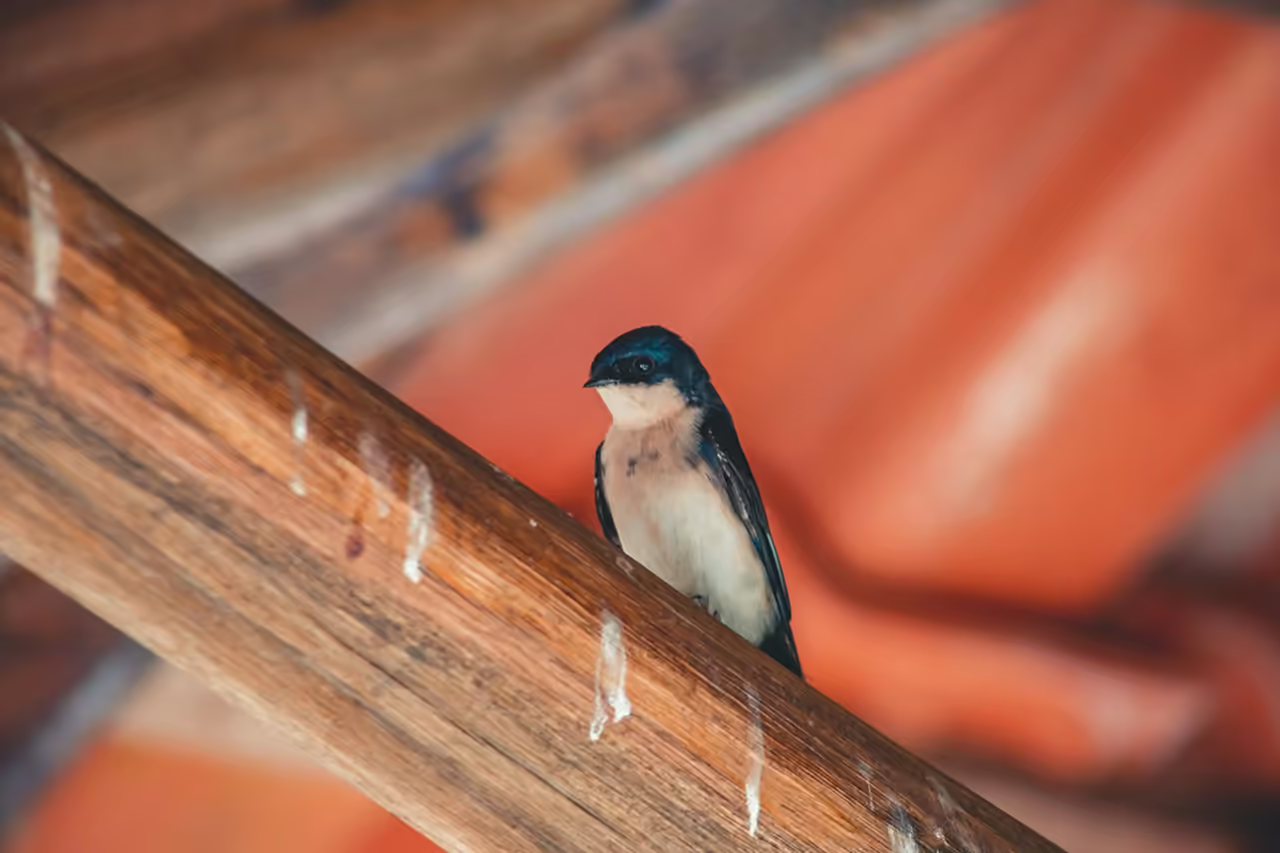
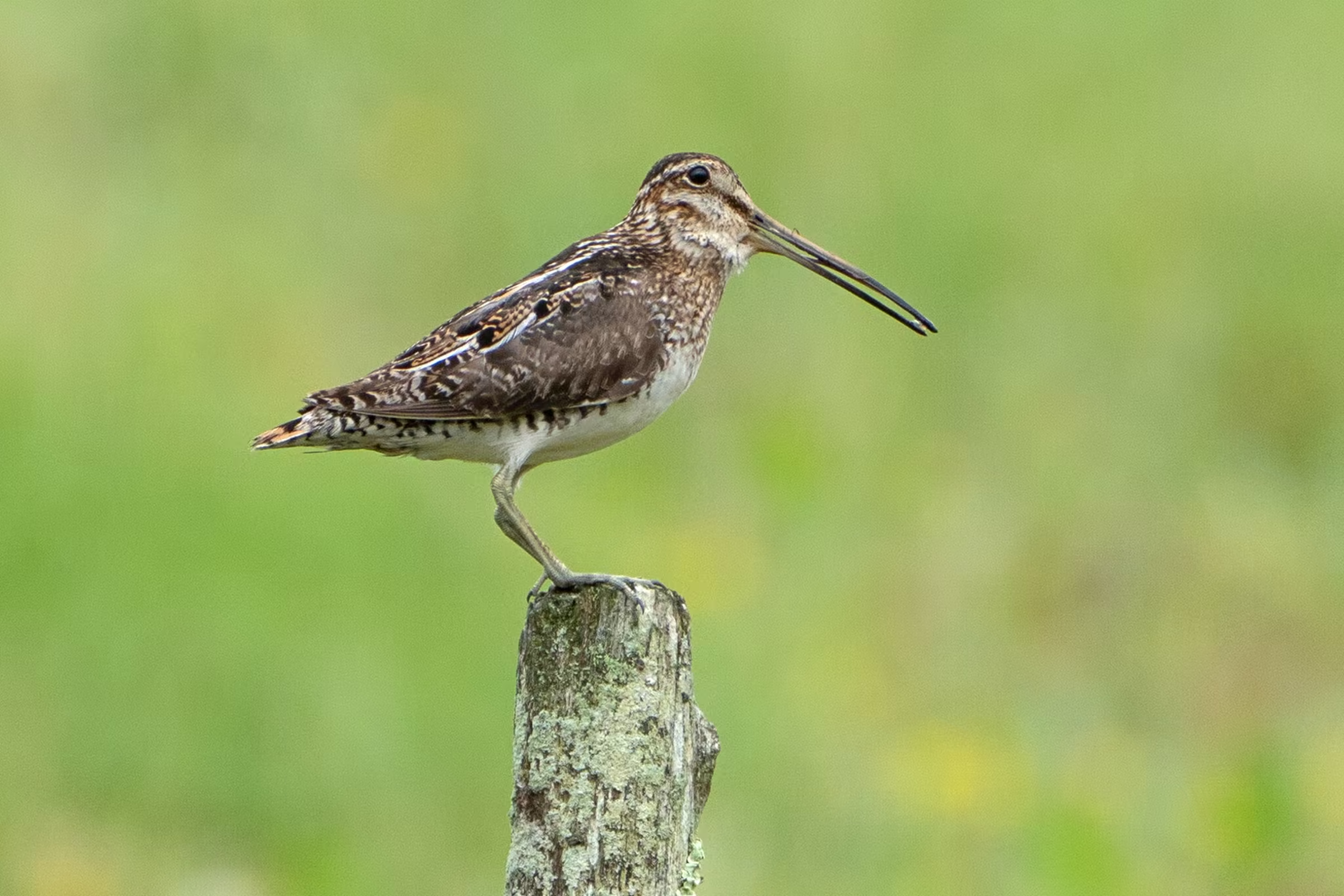 From the bird of the dayWilson's SnipePlump, well-camouflaged shorebird that blends into wet meadows and marshes.A new bird every day, with its call →
Why BirdTab?
Daily Nuggets
Bite-sized, scientifically accurate facts that are easy to absorb and remember — paired with a matching species image.
Science Based
Every bird comes with a species description, its IUCN Red List status, and a range map and species page from eBird.
Conversation Starters
Walk away from each new tab with something genuinely interesting to share. Bird facts are consistently surprising.
Benefits
Continuous Learning
Expand your knowledge of natural history, biology, and ecology without setting aside any dedicated study time.
Genuinely Surprising
From the fastest diving speeds to the most complex tool use, birds routinely defy expectations. Nature is never boring.
Family Friendly
A wonderful way to get children interested in nature, science, and biology through genuinely engaging daily facts.
How It Works
1
Get the Fact
A new bird appears with every new tab — its photograph paired with a short species description and conservation status.
2
Explore Further
Facts often include species names and behaviors that make it easy to search for more depth if the topic catches your interest.
3
Share
Bird facts make great conversation starters. Pass one on to colleagues, friends, or family.
The Surprising Science of Birds
The world of birds is full of surprises that challenge our assumptions about intelligence, evolution, and what animals are capable of. Consider that Ravens have been shown in controlled experiments to plan for the future — setting aside tools they'll need later, even when doing so conflicts with immediate rewards. This was previously thought to be uniquely human.
Or that Arctic Terns fly a round trip of about 90,000 km each year — equivalent to three round trips to the Moon over a lifetime. Or that the Lyrebird can reproduce almost any sound it hears, including chainsaws, camera shutters, and car alarms, with stunning acoustic accuracy.
These facts aren't just trivia — they reveal how diverse and sophisticated life on Earth has become. BirdTab makes this learning effortless by surfacing one fascinating fact at a time, letting you absorb the breadth of avian biology over weeks and months of daily browsing.
Why Micro-Learning Works Better Than Studying
Cognitive science has repeatedly shown that spaced repetition — encountering information multiple times across distributed intervals — produces dramatically better long-term retention than massed practice (studying a lot at once). This is the principle behind flashcard apps like Anki, and it's also the principle behind BirdTab.
By encountering a new bird fact or species every time you open a new tab, you're engaging in micro-learning sessions that your brain processes and consolidates naturally. You're not studying — but you are learning, and at a pace that sticks.
Over a year of regular browsing, BirdTab users meet hundreds of species, each with its own photograph, call and facts. Many report that they begin recognizing birds in the wild that they've seen in BirdTab — a direct transfer of passive digital learning to real-world observation skills.
Frequently Asked Questions
What are some of the most fascinating bird facts?
Birds are full of surprises. The Peregrine Falcon is the fastest animal on Earth, reaching dive speeds over 240 mph. The Clark's Nutcracker can remember the exact locations of up to 30,000 individual seed caches across a winter. The lyrebird can perfectly mimic chainsaws, camera shutters, and car alarms in addition to other bird species. Arctic Terns migrate 90,000 km round-trip annually — the longest migration of any animal. The Common Swift can spend up to 10 months continuously airborne, sleeping, eating, and even mating in flight.
What is the most intelligent bird species?
Corvids — the family that includes ravens, crows, jays, and magpies — are widely considered the most intelligent birds. Studies show crows can solve multi-step puzzles, use tools, plan for the future, and recognize individual human faces. New Caledonian Crows craft hooked tools from leaves and sticks to extract food — a level of tool use once thought exclusive to primates. Ravens demonstrate theory of mind (understanding that others have different knowledge than themselves) and can delay gratification, passing versions of the famous marshmallow test. Parrots, particularly African Greys, also demonstrate exceptional cognitive abilities, including basic symbolic reasoning.
How do birds navigate during migration?
Birds use a remarkable array of navigation systems simultaneously. Most species detect Earth's magnetic field using magnetite crystals in their beaks and a light-sensitive protein in their eyes called cryptochrome, which may literally let them "see" magnetic field lines. They also use the position of the sun (with an internal circadian clock to correct for time of day), star patterns at night, infrasound (low-frequency sounds from coastlines and mountains), familiar landmarks, and smell. This redundant, multi-sensory navigation system makes migrating birds extraordinarily accurate — some return to the exact same nest site within meters, year after year.
What bird has the largest wingspan?
The Wandering Albatross holds the record for the largest wingspan of any living bird, reaching up to 3.7 meters (12 feet). This vast wingspan enables dynamic soaring — a technique where albatrosses extract energy from wind shear above ocean waves without flapping, allowing them to travel thousands of miles while burning almost no energy. They can circumnavigate the Southern Ocean multiple times in a single year. Among land birds, the Andean Condor has the largest wingspan at up to 3.3 meters.
Can birds really recognize human faces?
Yes — and the research is well-documented. Studies at the University of Washington showed that American Crows can individually recognize and remember human faces for years, passing that knowledge to their offspring and other flock members. Mockingbirds, Cassowaries, and several other species also show facial recognition abilities. Perhaps most remarkably, a 2011 study found that crows that had been caught, banded, and released began recruiting other crows to mob the specific researcher who had caught them — even when he was disguised with masks.
Do birds dream?
Evidence strongly suggests yes. Zebra finches show brain activity during sleep that mirrors the neural patterns of singing while awake — essentially rehearsing their songs in their sleep. This parallels REM sleep in humans and other mammals. Some birds even show subtle beak and leg movements during these sleep states, suggesting active dream states. The discovery of REM-like sleep in birds (whose brains evolved independently of mammalian brains) suggests sleep's restorative and learning functions may be universal across vertebrates.
What are the rarest birds in the world?
Among the rarest birds currently known to survive: the Madagascar Pochard (fewer than 25 individuals), the Spix's Macaw (extinct in the wild, reintroduction efforts underway), the Regent Honeyeater (around 300-400 individuals remaining in Australia), the Kakapo (around 250 individuals, all individually named by conservationists in New Zealand), and the California Condor (recovered from just 27 individuals in 1987 to over 500 today, one of conservation's great success stories). BirdTab shows the IUCN Red List status of the birds it features, so threatened species stand out when they appear.
Ready to transform your new tab?
What Our Community Says
100+ reviews on the Chrome Web Store, all 5 stars.
“Love, Love, Love this bird app! Birds I never knew exsisted, now revealed! And I can pick a region anywhere in the world! Thanks birdtab.app! ”

“Fantastic extension, I can easily explore the nature all over the world simply via my browser. ”

“So nice to open the browser and have a gorgeous singing/calling bird instead of the same old google search page! ”

“The reason I love opening up a new tab. As an ornithologist and birder, this is my favorite extension. ”

“Happy to see nice birds from my region whenever I surf the web, will definitely show my ornithologist colleagues! ”

“I am obsessed with birds, and I love this extension so much that it's hard to put into words. I love discovering a new bird species with every tab I open. Thank you for making this extension for bird lovers like myself. ”

“I was looking for a high-contrast theme for Brave because it's annoyingly difficult to see your active tab among all the rest in that browser, but then I found this and obviously had to have it. I still can't find what tab I'm in, but every time I see a wonderful new bird, it's worth it. ”

“Amazing extension! Opening a new tab feels like a breath of fresh air :) I'm learning about new birds, appreciating the birds around me more, and taking much-needed tiny pauses in the day. Thank you, birdtab! ”

