
Is Birdwatching Good for Your Brain? What the Research Says
Expert birders' brains, birdsong and anxiety, and why a few birds a day may lift your mood for hours: what nine studies found, what they didn't, and how to get the benefits.
Birders have always said that watching birds makes them feel better. Over the last ten years, researchers have started to test it: with brain scans, with smartphone surveys, with hidden speakers on hiking trails and with experiments on college campuses.
The results are encouraging, and they are also easy to overstate. This post goes through what nine studies actually found, what they can't tell us yet, and how to bring more birds into an ordinary day.
The short answer
- Expert birders' brains look different. In a 2026 brain-imaging study, people who were very good at identifying birds had more compact tissue in regions used for attention and perception, and those regions seemed to change less with age.
- Seeing or hearing a bird is linked to a better mood, and the lift was still measurable hours later, in people with and without depression.
- Birdsong calms. Six minutes of recorded birdsong reduced anxiety in an online experiment; hikers who heard extra birdsong on a trail felt more restored.
- Birdwatching beat a plain nature walk for wellbeing in a small campus experiment.
- People who live among more birds report being happier with their lives, even after accounting for income.
Most of these studies show a link, not proof that birds cause the change. The experiments are small. But they point the same way.
Expert birders have measurably different brains
In February 2026, researchers at Baycrest in Toronto published a study in the Journal of Neuroscience comparing 29 expert birders with 29 beginners of the same ages and sexes, from 22 to 79 years old. They scanned their brains with diffusion MRI, which measures how freely water moves through tissue, and asked everyone to identify birds in the scanner.
The experts had lower mean diffusivity, a sign of denser, more structured tissue, in frontal and parietal regions used for attention and in the posterior areas that handle visual perception. Within the experts, the more compact these regions were, the more accurately they identified birds. And across the age range, the same regions showed a trend toward changing more slowly with age in the experts than in the beginners. The authors describe it as "potential attenuation of age-related decline."
Two cautions. The study compares two groups at one point in time, so it can't show that birding caused the difference: people with these brains may simply be drawn to birding. And it is about expertise, the years of learning to tell one warbler from another, not about looking at birds now and then. What it does suggest is that the skill of identifying birds is the kind of demanding, lifelong learning that leaves a mark on the brain.
A bird a day: the mood lift lasts for hours
From 2018 to 2021, researchers at King's College London asked 1,292 people to report on their surroundings and their mood three times a day through a smartphone app called Urban Mind. Over 26,856 check-ins, people's mental wellbeing was higher when they had just seen or heard birds, and the effect could still be detected up to eight hours later.
Two details stand out. The link held for people with a diagnosis of depression as well as for those without one. And it wasn't explained by trees, plants or water nearby: it was the birds. As with any study of this kind, it shows a link rather than a cause, and most participants were in the UK, Europe and the US.
Birdsong turns down anxiety
Some of the clearest evidence is about sound.
In a randomised online experiment from the Max Planck Institute for Human Development, 295 people listened to six minutes of either traffic noise or birdsong. Anxiety and paranoid thoughts dropped after birdsong, with medium-sized effects, and did not drop after traffic. Traffic noise made people more depressed; birdsong with many species in it eased depression slightly. One honest note: birdsong had no effect on the memory and attention tests, so this is a finding about mood, not about thinking faster.
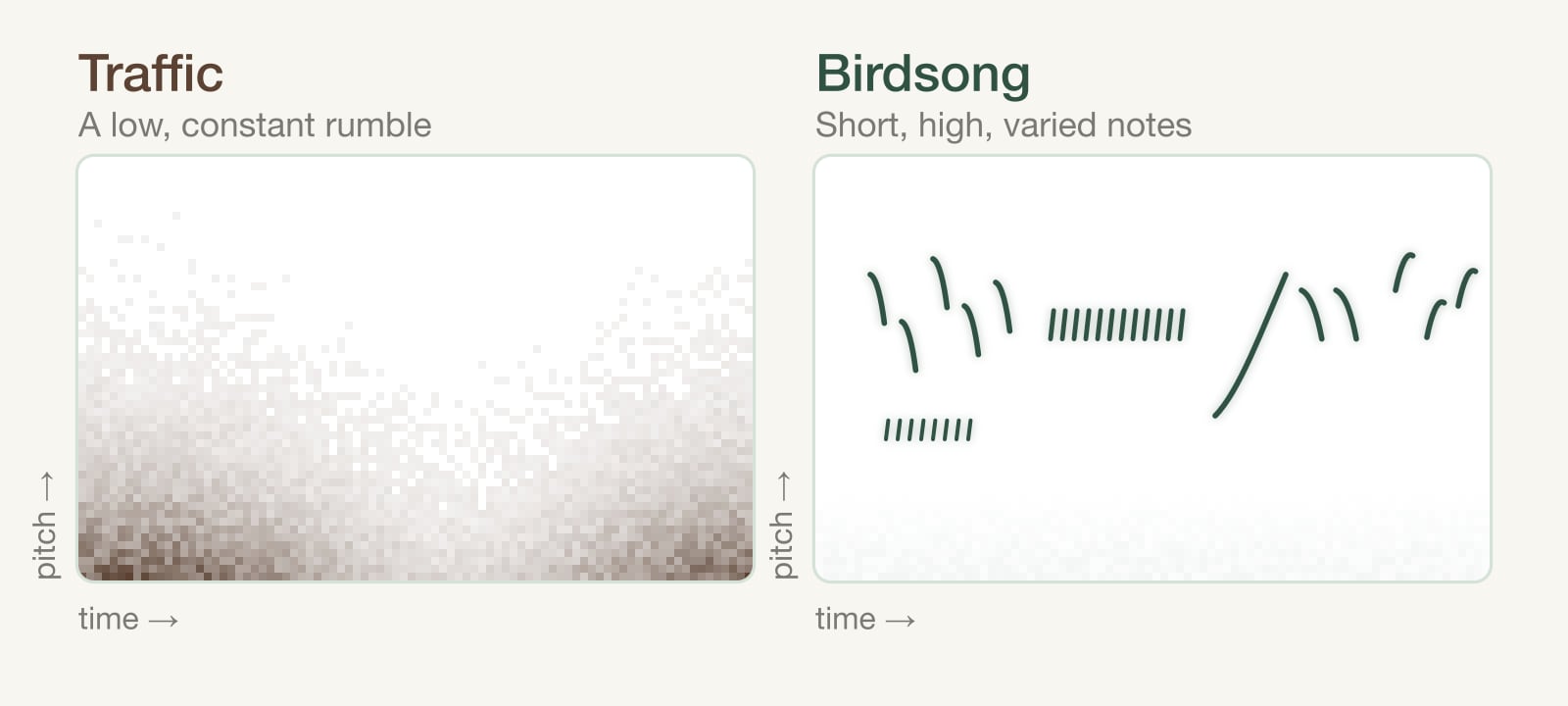
What the two soundscapes look like as sound pictures (sonograms). An illustration, not the study's recordings.
A team of US researchers went further and hid speakers along two trails in Boulder, Colorado, playing a "phantom chorus" of birdsong during some periods and switching it off during others. Of the 665 hikers surveyed, those who passed during the birdsong periods reported feeling more restored. In both studies, the birdsong was a recording, which is worth remembering.
Birdwatching versus a walk in the park
Is it birds in particular, or just being outside? A pilot experiment at North Carolina State University compared students who did five weekly birdwatching sessions of 30 minutes or more, students who took five nature walks, and a control group who did neither.
Wellbeing went up in all three groups, but the birdwatchers started lowest and finished highest. Both birdwatching and walks reduced psychological distress compared with the control. The authors call it a pilot and ask for larger studies, but it is one of the few experiments to test birdwatching itself rather than nature in general.
More birds around you, more satisfied with life
Two larger surveys look at where people live.
A European study used the 2012 European Quality of Life Survey and bird atlas data across the continent. People who lived in places with more bird species were more satisfied with their lives, even accounting for income, health and other factors, and the association with bird diversity was about as strong as the one with income. Trees and mammals showed no such link. "Avian diversity is as important for their life satisfaction as is their income," one of the authors said, while warning that a survey like this can't prove cause.
In England, a study of 263 people found that those who lived in neighbourhoods with more birds in the afternoon, when people are out and about, had lower levels of depression, anxiety and stress.
Why it might work
Researchers offer a few explanations, and they probably add up rather than compete.
It rests your attention. Attention restoration theory holds that the effortful focus we use for work tires, and that nature holds attention gently enough to let it recover. Even brief views help: in one experiment, students who looked at a green, flowering roof for 40 seconds made fewer errors on an attention task afterward than those who looked at bare concrete.
It's a skill that keeps growing. There are about 11,000 bird species and you can always learn another call, another plumage, another bird you've never noticed. That steady, demanding learning is what the brain-imaging study points to.
It gets you outside and moving. A study of nearly 20,000 people in England found that those who spent at least 120 minutes a week in nature were more likely to report good health and wellbeing, whether they did it in one visit or several. Birding is a reason to go, and to stay longer once you're there.
It brings you into the present. Waiting for a bird to move, or straining to hear which bird is singing, pulls attention away from the to-do list. We wrote about that side of it in Bird Watching and Mindfulness.
From the BirdTab team
A new bird, every time you open a tab
10,000+ species, stunning photography, and bird calls — delivered quietly to your browser. Free, always.
Add to Chrome — It's FreeHow to get the benefits
None of this needs binoculars or a trip. Start with what's around you.
- Give birds ten minutes a day. At a window, on a balcony, on the way to work. The Urban Mind study counted ordinary sightings, not birding trips.
- Learn your local birds. Start with the ten most common ones near you. Birds near me shows what has been reported in your area recently, and the checklist for your country or state lists everything recorded there.
- Learn them by ear. Many birds are heard before they are seen, and listening works even when you can't look up. Put on birdsong while you work and try to name the singers.
- Test yourself. Recognising a bird is the skill the brain study measured. The bird quiz helps you remember what you've learned.
- Aim for two hours outside a week. Spread over several walks if that's easier; the effect in the 120-minute study didn't depend on doing it all at once.
- Keep a list. Writing down what you see makes you look more carefully, and it is satisfying to watch it grow. Here's how to keep a life list.
Where BirdTab fits
We make BirdTab, so take this part with that in mind. No study has tested BirdTab, and a browser tab is no substitute for going outside. But it is built around the parts of the research that can happen at a desk:
- A short break with a bird in it. Every new tab shows a bird photo, often with its song. You open dozens of tabs a day, so that is dozens of small pauses, a little like the 40-second green-roof break.
- Birdsong, recorded. The anxiety and trail studies used recordings too. BirdTab plays the bird's own call, with volume and quiet hours you set.
- Your own country's birds. Choose from more than 250 countries and regions, so the birds you learn on screen are the ones outside your window.
- Practice at identifying. Turn on Guess the bird and each new tab hides the name until you click; the built-in quiz tests you on ten birds; Your Birds keeps every bird you've seen, with a quiz on just those. Names appear in your own language.
It's free, with no ads and no account.
What the research doesn't say yet
- Cause and effect. The brain, life-satisfaction and neighbourhood studies are snapshots. They can't rule out that healthier, happier people simply live near more birds or take up birding.
- Small samples. The brain study had 58 people; the campus experiment was a pilot.
- Who was studied. Most participants were in Europe and North America, many of them young smartphone users or students.
- Not a treatment. None of this replaces care for depression or anxiety. It suggests that birds are a good thing to add to a day, not a cure.
The direction is still clear, and the cost of trying is a few minutes. Look up, listen, and learn the name of one more bird this week.
Sources
- Wing, E. A., Chad, J. A., Mariotti, G., Ryan, J. D. & Gilboa, A. (2026). The Tuned Cortex: Convergent Expertise-Related Structural and Functional Remodeling Across the Adult Lifespan. Journal of Neuroscience 46, e1307252026.
- Hammoud, R. et al. (2022). Smartphone-based ecological momentary assessment reveals mental health benefits of birdlife. Scientific Reports 12, 17589.
- Stobbe, E. et al. (2022). Birdsongs alleviate anxiety and paranoia in healthy participants. Scientific Reports 12, 16414.
- Ferraro, D. M. et al. (2020). The phantom chorus: birdsong boosts human well-being in protected areas. Proceedings of the Royal Society B 287, 20201811.
- Peterson, M. N. et al. (2024). Birdwatching linked to increased psychological well-being on college campuses: A pilot-scale experimental study. Journal of Environmental Psychology 96, 102306.
- Methorst, J. et al. (2021). The importance of species diversity for human well-being in Europe. Ecological Economics 181, 106917.
- Cox, D. T. C. et al. (2017). Doses of neighborhood nature: the benefits for mental health of living with nature. BioScience 67(2), 147–155.
- Lee, K. E. et al. (2015). 40-second green roof views sustain attention: the role of micro-breaks in attention restoration. Journal of Environmental Psychology 42, 182–189.
- White, M. P. et al. (2019). Spending at least 120 minutes a week in nature is associated with good health and wellbeing. Scientific Reports 9, 7730.