Wandering Tattler
Tringa incana

Play its call
About the Wandering Tattler
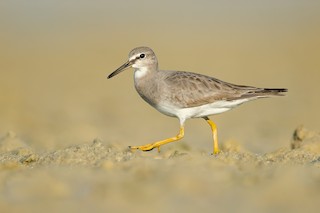
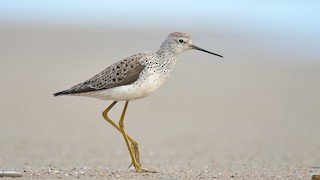
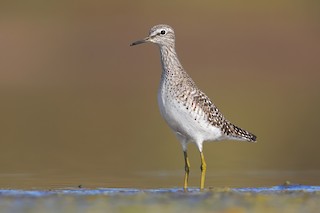
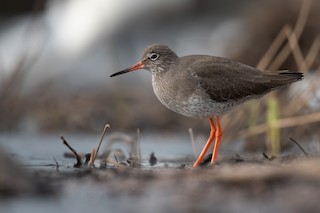
Medium-sized, gray shorebird with short yellow legs and straight bill.
Elongated, horizontal posture. In breeding plumage, look for jaggedly barred underparts and thin white eyebrow; similar in winter but with plainer gray underparts. Usually found on rocks, where it typically forages independently while bobbing its tail up and down. Sometimes close to other rock-loving shorebirds like turnstones, Surfbird, and Rock Sandpiper. Compare with extremely similar Gray-tailed Tattler, which overlaps extensively in range in western Alaska, the South Pacific, Australia, and parts of Asia. Wandering is more closely associated with rocky habitats as opposed to beaches and mudflats, but this shouldn’t be used as a definitive field mark. Plumage differences are very subtle. In breeding plumage, Wandering averages coarser and more extensive barring on underparts, and juveniles usually have darker gray flanks. All ages have a longer groove on the upper mandible. Best characteristic is voice: Wandering typically gives a ringing trilled call, much different than Gray-tailed’s two- or three-noted “too-wee” call.
Species account: eBird.org, fetched 2025-12-26 · How these pages are made
Call and song
Where it has been recorded
Recorded in 44 of the 253 countries we have eBird lists for. Each opens that country's checklist.
- American Samoa
- Australia
- Canada
- Chile
- Clipperton Island
- Colombia
- Cook Islands
- Costa Rica
- Ecuador
- El Salvador
- Fiji
- French Polynesia
- Guam
- Guatemala
- High Seas
- Indonesia
- Japan
- Kiribati
- Marshall Islands
- Mexico
- Micronesia
- Nauru
- New Caledonia
- New Zealand
- Nicaragua
- Niue
- Norfolk Island
- Northern Mariana Islands
- Palau
- Panama
- Papua New Guinea
- Peru
- Pitcairn Islands
- Russia
- Samoa
- Solomon Islands
- Taiwan
- Tokelau
- Tonga
- Tuvalu
- United States
- United States Minor Outlying Islands
- Vanuatu
- Wallis and Futuna